
Desk Worker Stretches: What Actually Helps (Physiotherapist-Approved)
Most office stretch routines target the wrong muscles. A PJ physiotherapist explains what desk work does to your body — and what to do about it.
Every week, someone comes into the clinic with a printed exercise sheet from another provider, or they pull out their phone to show me a YouTube routine they've been doing faithfully for three months. "I'm stretching," they tell me. "But nothing's getting better."
I look at the exercises. Nine times out of ten, the problem is obvious. They're stretching the wrong things.
Most generic stretch routines for desk workers were designed without a clear picture of what prolonged sitting actually does to the body. When you stretch a muscle that doesn't need stretching, you don't just waste time — you can make the underlying problem worse.
The two-problem reality of desk work
Desk work creates two types of muscle dysfunction simultaneously, and they need completely different interventions.
Some muscles work overtime to hold your posture together and end up chronically tight and shortened. Others, no longer asked to do much, gradually switch off — they don't just get weak, they lose the ability to activate properly. Generic stretch routines address the first problem inconsistently and ignore the second entirely. Worse, they often stretch muscles that are already inhibited, which can destabilise the joints those muscles are meant to support.
If you want to understand the longer-term structural consequences of this pattern, I wrote about it in depth in what decades at a desk does to your spine.
What's actually tight in desk workers
If you sit for most of your working day, these are the muscles that are genuinely overactive and need lengthening.
Hip flexors (iliopsoas and rectus femoris) — not your hamstrings. Sitting keeps your hips in sustained flexion for 8+ hours. The hip flexors adaptively shorten. Yet almost every desk worker stretch routine I see prioritises hamstring stretches. Your hamstrings are not why your lower back hurts.
Upper trapezius and levator scapulae — the muscles that shrug and hike your shoulders toward your ears. Keyboard work and forward head posture load these constantly.
Pectoralis minor — the small chest muscle that pulls your shoulder blade forward and down. Consistently overlooked, but a major driver of the rounded-shoulder posture that loads your neck and mid-back.
Suboccipitals — the small muscles at the base of your skull. Forward head posture compresses them chronically. This is often the source of the "heavy head" and headache complaints I see in desk workers.
What's actually inhibited
These muscles aren't firing properly — and stretching will not fix them.
Deep neck flexors — the muscles at the front of your neck that support your head from within. Most desk workers have almost no voluntary activation here. Without it, the upper trapezius and levator scapulae take over, which is a direct line to neck pain and headaches.
Lower trapezius and serratus anterior — responsible for stabilising your shoulder blade against your ribcage and rotating it upward. When these don't fire, your upper traps compensate again.
Gluteus maximus and medius — sitting switches these off. When they're inhibited, your lower back and hip flexors have to compensate for every movement. This is one of the most underappreciated drivers of chronic lower back pain in otherwise healthy desk workers.
Deep abdominals (transversus abdominis) — not the six-pack muscles, but the deep stabilising layer of the trunk. Inhibited, not tight. Stretching your core is not what's needed here.
The stretches that actually matter
Based on the above, here's what I'd prioritise for most desk workers.
Hip flexor stretch in a lunge position. One knee on the ground, the other foot forward. Tuck your pelvis slightly — you should feel a deep pull through the front of your rear hip. Hold for 30–45 seconds each side, twice daily. This is the lower back intervention that most people aren't doing.
Thoracic extension over a rolled towel or chair back. Place a rolled towel horizontally across your mid-back and extend gently over it, working through different levels of the thoracic spine. This is infinitely more useful than neck rolls for desk-related mid-back stiffness, because the stiffness is thoracic, not cervical.
Pec minor doorway stretch. Stand in a doorway with your elbow at shoulder height, forearm against the frame. Step one foot forward and rotate your chest away from the door. You should feel this in the chest, just below the collarbone — not the shoulder. Two minutes of this addresses what hours of neck stretching won't touch.
Chin tuck (deep neck flexor activation). This isn't a stretch — it's an activation exercise. Sit upright, look straight ahead, and gently draw your chin straight back (not down). Think "make a double chin." Hold for 5–10 seconds, repeat 10 times. This is the single most valuable exercise I give desk workers. It activates the deep neck flexors and directly counters the forward head position that loads your suboccipitals and upper traps.
90/90 hip stretch for external rotators. Sit on the floor with both hips at 90 degrees — front leg and back leg both bent at right angles. Hinge forward over your front shin. This targets the deep hip external rotators that tighten in desk workers and contribute to both hip and lower back pain.
What not to bother with
Neck rolls — the gentle circular movement in virtually every office stretch video — do very little for the muscles actually causing desk-related neck pain. Your suboccipitals need targeted extension release, not passive circling.
Generic hamstring stretches for lower back pain are another one to reconsider. Unless your assessment has specifically identified short hamstrings as a contributing factor, this is unlikely to shift your back pain. The hip flexors, thoracic spine, and glutes are almost always the higher-priority targets.
What stretching can't fix
Everything above addresses the tight, overactive side of the equation. But the inhibited muscles — the deep neck flexors, lower traps, glutes, and deep abdominals — will not respond to stretching. They need activation work: specific exercises that retrain firing patterns, usually progressed over several weeks.
This is why a home programme prescribed after an assessment is different from a generic stretch routine. When I assess a patient, I can see which muscles are short, which are inhibited, and which compensation patterns have developed. The programme that comes out of that is specific to that person's body — not a general list.
Generic stretches are better than nothing. But they're a ceiling, not a solution.
If you're in PJ or Subang and you've been managing neck or back tension with routines that aren't moving the needle, it may be worth finding out what your specific pattern needs. You can read about what a workplace physiotherapy assessment involves, or WhatsApp me directly to book at Pinpoint in Ara Damansara.
If the workstation itself is part of the problem, use our ergonomic workstation setup guide for Malaysia alongside the movement plan above.
Related articles.
If this piece helped, these will too.

Running Injuries Malaysia: Why It's Not Your Shoes
Running injuries in Malaysia often start after a mileage jump, not a bad shoe. A Subang physio on load, runner's knee, shin pain, and safer return.

Pickleball Injuries Malaysia: Not Easier Badminton
Pickleball injuries in Malaysia often start after three weeks of 'easy' play. A Subang physio on elbow, Achilles, and why volume beats the myth.
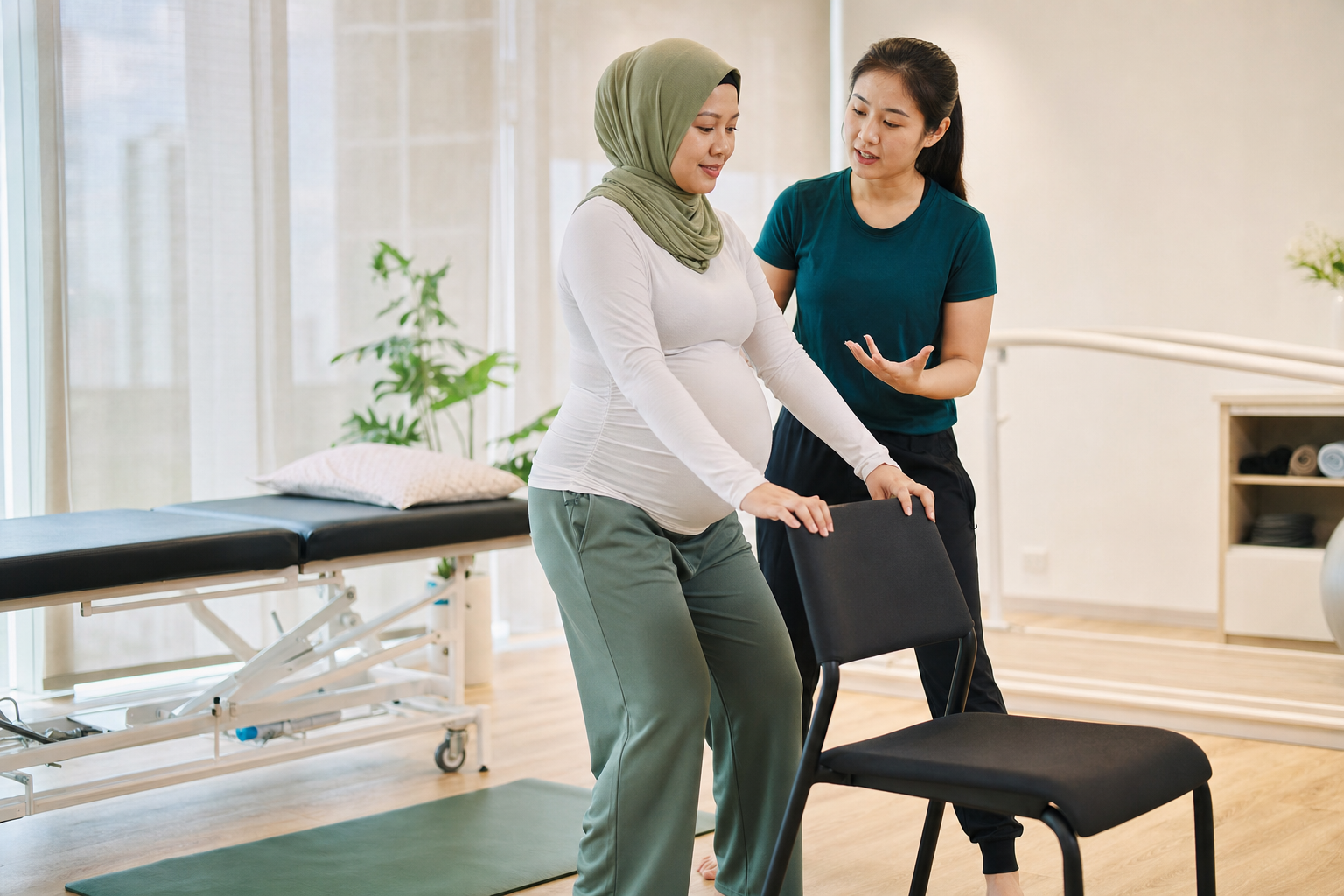
Back Pain in Pregnancy: What's Safe and What Helps
Back pain in pregnancy is common, but you do not have to simply endure it. Learn what is safe, when physiotherapy helps, and when to seek medical care.
Book an assessment.
60 minutes. One-to-one with Felicia. Reply on WhatsApp within a few hours.
Message on WhatsApp