How to help your elderly parent move safely at home
Help an elderly parent move safely by letting them push up while you steady. What to change for the chair, toilet, car, and a fall on the floor.
Mum is halfway off the sofa. You are already behind her, hands hooked under her arms, because that is how you got her up last Sunday. The floor is dry. Your lower back complains on Monday. She says jangan fuss.
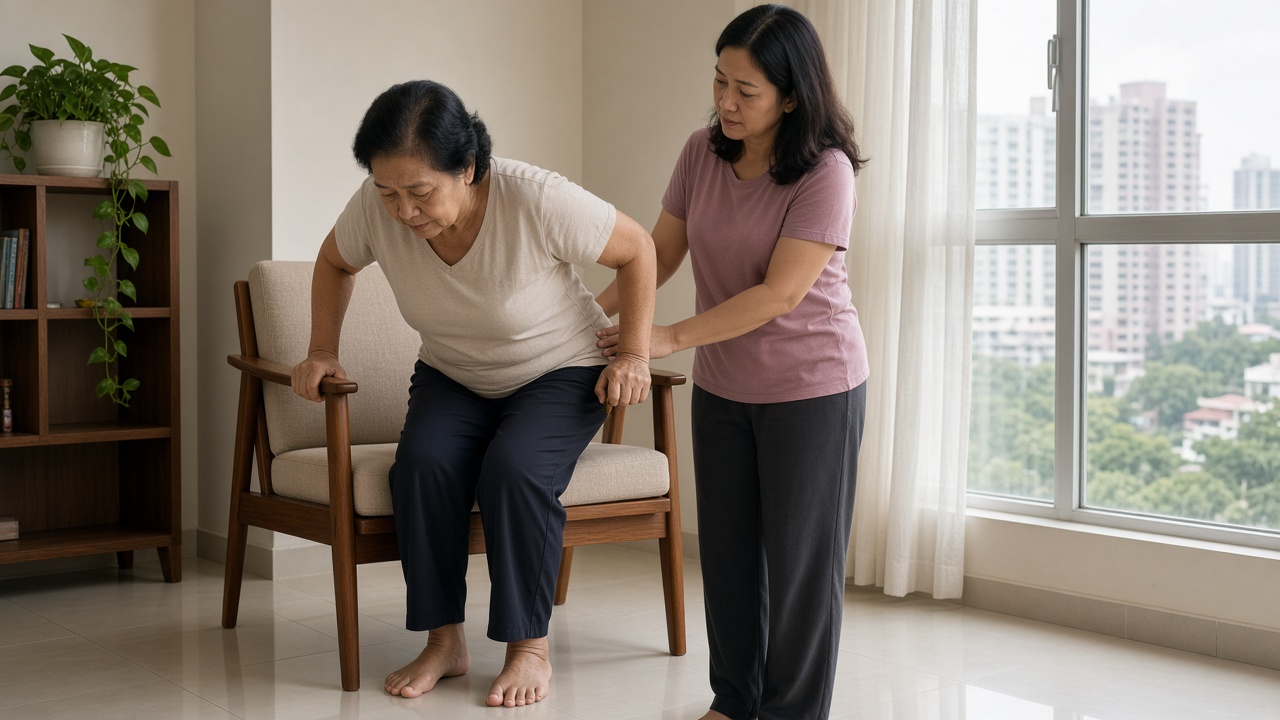
Helping an elderly parent move safely means she does the push. You stay beside her and steady her. A lift is how both of you get hurt.
The heave loads a back and a shoulder
Carers who move someone else often hurt their own backs, and a poor lift can break fragile skin or leave bruises and cuts. If you do this most days, have a clinician show you. The NHS page on moving someone else says so, and asks you to try equipment before you buy it.
Darragh and colleagues asked 46 unpaid carers in the United States who lived with the person they helped. Transfers were the hardest work: toilet, bed, shower, chair, car, stairs, and getting someone up after a fall. Nearly all had recent aches, most often in the low back. Those 46 people were already doing heavy hands-on care.
Pulling under the arms is what we see at home. A Gwynedd Council leaflet for carers warns that dragging on the arms, or holding under the armpit, can bruise the shoulder, tear soft tissue, or dislocate the joint. Dragging means they need another assessment.
How to help an elderly parent move from a chair
Least help means they keep every part of the stand they can still do. Helping every time takes the practice away. Cue first. Use your hands only if the cue is not enough. Specialist physiotherapist Bhanu Ramaswamy says this to families on the Parkinson's UK assistance page.
When the legs can take weight, talk them through a Plymouth physiotherapy leaflet from August 2025:
- Bottom forward, to the edge of the seat.
- Feet back, heels flat.
- Lean until the nose is over the toes. A small rock can help them start.
- Push up from the armrests, or the edge of the seat, and look ahead.
- Take a walking frame only once they are up. Holding it to stand can tip it backwards.
If they still need you, stand at their side. Support through the lower back and push forwards and up with them. Their arms stay free for the armrests.
A handling belt is for someone who can already support their own weight, to guide a stand or a walk. UK Health and Safety Executive guidance says not to use it for lifting. If the legs will not take weight, stop and get the move assessed. Ask whether a hoist is needed.
A deep sofa fights the push. A firm chair with arms lets the feet sit flat. Taking over every stand feels kinder after a scare, and the legs lose the work. We wrote about that in what to do when a parent is slowing down.
Toilet, the car, and the stairs
Wet tiles and a low toilet are where the invented hold starts. A raised seat and a rail fixed into a solid wall let them push. A shower chair lets them sit while the floor is soapy. NHS falls advice suggests bathroom grab rails, rails on steps, a non-slip mat, and shoes that stay on. A towel rail was not put there to take a person's weight.
The car is the same push: seat back, come forward, push up. Do not lift them clear of the seat.
On stairs they hold a rail, one step at a time. Which leg leads, when one side is weaker, is something we show on that flight. If they are already unsteady on the flat, book before the stairs become the practice. A slower walk has its own checks in our guide for families.
On the floor, do not lift
Ask where it hurts, and whether they can get up. Call emergency services if the head, back, neck, or hip may be injured, or they cannot get up. Keep them warm. If they can get up, they do it: roll to the side, onto hands and knees, crawl to a solid chair, one foot flat, push up, then sit and rest. Guide them. Do not lift. The steps are on the NHS falls page.
A drooping face, an arm that will not stay up, or slurred speech needs an emergency call even if it fades. NHS stroke advice lists it as FAST: face, arms, speech, time.
NICE falls guidance (NG249, 2025) asks for a full assessment after a fall in the past year if the person is frail, needed treatment for an injury, blacked out, could not get up alone, or has fallen twice or more. Tell their doctor, including the fall they talked you out of reporting.
Bring the chair they actually use
Come in before the next heave if you move them most days and nobody has shown you, if the legs will not take weight, if your back or their shoulder already hurts, or if the bathroom and stairs are guesswork. That visit is how you help an elderly parent move safely in the flat or terrace you already have.
Message us on WhatsApp before the next attempt on that sofa. Pinpoint Physiotherapy is in Ara Damansara. Tell us which seat they struggle with, and whether anyone has fallen this year.
Sources
- NHS. How to move, lift and handle someone else. Reviewed 29 April 2024.
- Darragh et al., 2013. Musculoskeletal discomfort, physical demand and caregiving activities in informal caregivers. Journal of Applied Gerontology 34(6):734-760.
- Gwynedd Council and Gwynedd Carers Partnership. Good back care and safer manual handling. No date on the leaflet.
- University Hospitals Plymouth NHS Trust. Top tips to stand safely. Issued August 2025.
- Parkinson's UK. How to safely provide assistance. Bhanu Ramaswamy. No date on the page.
- Health and Safety Executive. Moving and handling equipment.
- NHS. Falls.
- NHS. Symptoms of a stroke. Reviewed 12 September 2024.
- NICE. Falls: assessment and prevention in older people and in people 50 and over at higher risk (NG249). Published 29 April 2025.
Related articles.
If this piece helped, these will too.
Strength training at 70: parents can still build muscle
Strength training after 70 can still build muscle. See what supervised sessions involve, what improves first, and when a check comes before you start.

Elderly parent walking slowly? When to get it checked
An elderly parent walking slowly may need more than extra rest. Learn which gait changes to notice, when to seek help, and how physiotherapy may help.
Pain after 60: Why age alone shouldn't explain it away
Pain after 60 deserves more than 'it's just age'. Learn when to seek medical help, how physiotherapy may help, and what realistic progress can look like.
Book an assessment.
60 minutes. One-to-one with Felicia. Reply on WhatsApp within a few hours.
Message on WhatsApp